 |
Appointments:
Associate Professor
Department of Pathology/MPMM
Committee on Immunology
Committee on Molecular
Medicine/MPMM
Committee on Molecular Metabolism
& Nutrition
Committee on Microbiology
|
Education:
M.D. 1st Moscow State Medical Institute
Ph.D. Cancer Research Center, Moscow
|
Contact:
Phone: (773) 702-1371
Fax: (773)
834-5251
E-Mail:
achervon@bsd.uchicago.edu
Address:
The University of Chicago
JFK R112
924 East 57th Street
Chicago, Illinois 60637
|
Related Research Interests:
|
|
Alexander Chervonsky, M.D., Ph.D.
Homing of Autoimmune T Cells to Targeted Tissues,
Selection of T Cells with Autoimmune T Cells in the Thymus, and the
Role of Innate Immune Mechanisms in Development of Organ-Specific
Autoimmnunity, such as Type 1 diabetes
Research Summary
Pathogenesis of autoimmune diseases is extremely
complex. We are interested in organ-specific diseases such as
autoimmune diabetes and psoriasis, and we have mouse models for both.
Our studies focus on determining how T cells are initially activated in
disease pathogenesis, how they home to the target organs, and how they
destroy these organs.
We have found that aberrant positive selection of T
cells is involved in autoimmunity. The role of this process in
autoimmunity is addressed using transgenic mouse models. T cell
receptors (TCRs) with an unusual feature—the ability to
interact with both major histocompatibility complex (MHC) class I and
MHC class II molecules—are being studied. Such T cells are
common in mice with a limited diversity of MHC molecules and a limited
diversity of peptides bound to the MHC. One such TCR, MM14.4, when
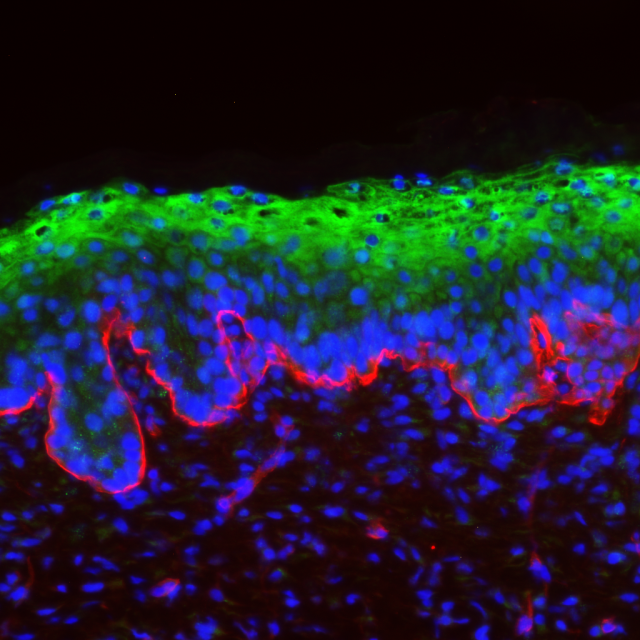
expressed as a transgene, causes skin lesions most closely resembling
human psoriasis. T cells carrying the MM14.4 TCR are selected into both
CD4+ and CD8+ T cell subsets. Other dual-restricted receptors have been
cloned, and additional transgenic mice carrying such receptors have
been generated and are being analyzed.
Using a mouse model for autoimmune diabetes, we have
started a new project to investigate the involvement of innate
Toll-like receptors (TLRs) in autoimmunity. TLRs are involved in
responses to infection with pathogens, but also maybe involved in the
activation of non-infectious immunity. These studies will help to solve
the longstanding riddle of how infection with pathogens is connected to
autoimmunity.
To address the issue of the homing of effector T cells
to their targets, we used insulin-specific CD8+ T cells (IS-CD8+).
Homing is a multi-step process that involves increased adhesion between
T cells and endothelial cells and subsequent extravasation
(diapedesis). Our studies of the molecular mechanisms of IS-CD8+ cell
trafficking to the islets have revealed a specific chemokine, CCL21,
participating in firm adhesion. Using a genetic approach, we obtained
new gene expression data on molecules involved in T cell homing to the
pancreas. Analysis of changes in gene expression in the pancreas from
mice treated with interferon gamma revealed that several chemokines
were upregulated in response to such treatment. The role of these
chemokines in the extravasation of islet-specific T lymphocytes is
being studied. In addition, we determined that homing of IS-CD8+ cells
to the pancreas is controlled genetically, and that some mouse strains
do not support homing of IS-CD8+ cells. We are currently studying the
underlying mechanisms, an understanding of which would allow us to
suggest new therapeutic measures to stop the trafficking of
auto-aggressive T cells to their targets.
We are also interested in how T cells that have reached
their targets destroy them. We have been focusing on the Fas-mediated
pathway of induced cell death. We previously determined that pancreatic
ß cells can express Fas under the influence of as yet unknown
signals from infiltrating T cells. We have now identified the nature of
the signal. We have also generated mice with a conditional knock-out of
Fas in ß cells, and we are studying diabetogenesis in these
mice under conditions when Fas is permanently removed from ß
cells during pathogenesis.
Another project deals with development and function of specialized
epithelial cells, termed M cells. M cells are necessary for
transepithelial transport of microbes for the purpose of probing the
microflora for the presence of pathogens, and are closely associated
with B lymphocytes. While studying the role of factors in the Tumor
Necrosis Family most commonly involved in organogenesis, we found that
production of these factors by B cells was completely dispensable for M
cell generation. Studies of other signaling pathways potentially
involved in molecular conversation between B and M cells are in
progress.
Selected Papers
Chervonsky AV, Gordon L, Sant AJ. (1994). A segment of
the
MHC Class II beta chain plays a critical role in targeting Class II
molecules to the endocytic pathway. Int Immunol 6:973-982.
Chervonsky AV, Sant AJ. (1995). In the absence of MHC
class II molecules, invariant chain is translocated to late endocytic
compartments by autophagy. Eur J Immunol 25:911-918.
Chervonsky AV, Xu J, Barlow AK, Khery M, Flavell RA,
Janeway Jr. CA. (1995). Direct, physical interaction involving CD40
ligand on T-cells and CD40 on B cells is required to propagate MMTV.
Immunity 3:139.
Chervonsky AV, Wang Y, Wong FS, Visintin I, Flavell RA,
Janeway Jr CA, Matis LA. (1997). The role of Fas in autoimmune
diabetes.
Cell 89:17-24.
Chervonsky AV, Medzhitov RM, Denzin LK, Barlow AK,
Rudensky AY, Janeway Jr CA. (1998). Subtle conformational changes
induced
in major histocompatibility complex class II molecules by binding
peptides. Proc Natl Acad Sci USA 95:10094-10099.
Chervonsky AV. (1999). Apoptotic and effector pathways
in
autoimmunity. Curr Opin Immunol 11:684-688.
Golovkina T, Shlomchik M, Hannum L, Chervonsky A.
(1999).
Organogenic role of B lymphocytes in mucosal immunity. Science
286(5446):1965-1968.
Golovkina TV, Agafonova Y, Kazansky D, Chervonsky AV.
(2001). Diverse repertoire of the MHC class II-peptide complexes is
required for presentation of viral superantigens. J Immunol
166:2244-2250.
Savinov A, Wong SF, Chervonsky A. (2001). IFN-gamma
affects homing of diabetogenic T cells. J Immunol 167:6637-6643.
Jude BA, Pobezinskays Y, Parke S, Medzhitov RM,
Chervonsky AV, Golovkina TV. (2003). Subversion of the innate immune
system by a retrovirus. Nature Immunol 4:573-578.
Savinov A, Tcherepanov A, Green EA, Flavell RA,
Chervonsky A. (2003). Contribution of Fas to diabetes development. Proc
Natl Acad Sci USA, 100:626-632.
Savinov A., Wong SF, Stonebraker A, Chervonsky A. (2003).
Cross-presentation of antigen by endothelial cells and chemoattraction
are required for homing of insulin-specifc CD8+ T cells. J Exp Med,
197:643-656.
Tumanov A, Kuprash DV, Mach JA, Nedospasov SA,
Chervonsky A. (2004). Lymphotoxin and TNF produced by B cells are
dispensable for maintenance of the follice-associated epithelium but
are required for development of lymphoid follicles in the Peyer's
pathces. J Immunol 173:86-91.
Logunova NN, Viret C, Pobezinsky LA, Miller SA, Kazansky
DB, Sundberg JP, Chervonsky AV. (2005). Restricted MHC-peptide
repertoire
predisposes to autoimmunity. J Exp Med 202(1):73-84.
Mach J, Hshieh T, Hsieh D, Grubbs N, Chervonsky A.
(2005).
Development of intestinal M cells. Immunol Rev 206:177-189
Stranges PB, Watson J, Cooper CJ, Choisy-Rossi CM, Stonebraker AC,
Beighton RA, Hartig H, Sundberg JP, Servick S, Kaufmann G, Fink PJ,
Chervonsky AV. (2007). Elimination of antigen-presenting cells and
autoreactive T cells by fas contributes to prevention of autoimmunity.
Immunity. 26(5):629-41. PMID: 17509906
Wen, L. , Ley, R.E, Volchkov, P.U., Stranges, B.P., Avanesyan,
L., Stonebraker, A.C., Hu, C.,, Wong, F.S., Szot,
G.L.,, Bluestone, J.A., Gordon, J.I & Chervonsky, A.V.,
(2008), Innate immunity and intestinal microbiota in the development of
Type 1 diabetes. Nature, 23:1109-13.
|
Faculty and Research
Programs
|