Olaf Schneewind, M.D., Ph.D.
Bacterial Pathogenesis and Protein Targeting
Research Summary
Our laboratory examines the mechanisms and strategies
whereby pathogenic bacteria cause human disease. Several different
microbes are being investigated.
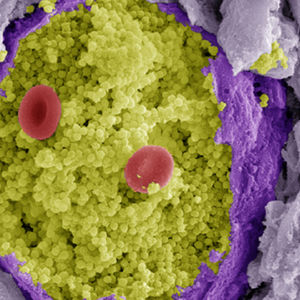
The cell wall of Staphylococcus aureus and other
Gram-positive pathogens can be viewed as a surface organelle with
anchored proteins that interact with the host environment during
infection. Our research has revealed four different mechanisms of
protein anchoring to the cell wall envelope. Surface proteins bearing a
C-terminal sorting signal with a LPXTG motif are cleaved by the sortase
A enzyme and linked to the cell wall crossbridges of peptidoglycan.
This group of surface proteins is essential for pathogenesis and
mediates bacterial attachment to host tissues and escape from the
immune system. Surface proteins bearing a C-terminal sorting signal
with a NPQTN motif are cleaved by sortase B. This mechanism is involved
in iron transport during infection and is required for bacterial
persistence in the host. Autolysins are enzymes that cleave the cell
wall envelope at defined sites. One group of autolysins, e.g.
lysostaphin and f11 hydrolase, is targeted to a receptor that is
distributed uniformly over the bacterial surface. Another autolysins is
targeted to the equatorial surface rings of staphylococci and mediates
peptidoglycan cleavage at cell divisions sites. Our laboratory
entertains genetic, molecular biological, biochemical, microscopic as
well as animal infectious strategies to reveal mechanisms of protein
targeting and the role in the establishment of disease. Our results are
useful for the design of new therapies that can be used for the
treatment of human infections caused by S. aureus and other
Gram-positive bacteria.
Pathogenic Yersinia spp. invade their human hosts and
colonize lymphoid tissues. This unique infectious strategy requires
bacterial mechanisms of immune evasion. Yersinia type III secretion
prevents the phagocytic killing of bacteria during infection. Further,
the type III machinery intoxicates and kills immune cells, thereby
impairing the host's ability to clear invasive Yersinia. In fact, the
pathogenesis of the most notorious of all pathogens, Yersinia pestis -
the causative agent of plague, relies on the type III secretion
machinery. We are interested in the mechanisms of protein recognition
and transport by the type III machinery. Our results suggest that mRNAs
of Yops, the substrates of the type III machinery, harbor signals that
lead to the secretion of the encoded polypeptide chains. Current work
is mapping the secretion signals and analyzing the mode of mRNA
recognition by the type III machinery. A second area of research is the
regulation of the type III secretion machinery. Upon bacterial entry
into the host, Yersinia sense three environmental signals: a
temperature shift to 37 ºC, glutamate ions as well as serum
proteins. These signals trigger yersiniae to express and assemble the
type III machinery and to transport YopB, YopD, YopR and LcrV into the
extra-cellular milieu. Docking of yersiniae on the surface of immune
cells leads to the insertion of type III secretion machinery needles
into the plasma membrane of host cells and in sensing of the low
calcium concentration of the cell's interior. Yersinia respond to the
low calcium signal by transporting YopE, YopH, YopM, YopN, YopO, YopP,
YopT and YscM (LcrQ) into the cytosol of host cells. The sum of the
function of these toxic proteins leads to a block in phagocytosis and
in the killing of macrophages. Research on type III secretion
represents a hotly contested frontier of microbiological science. Our
results will be useful for the treatment of human infections caused by
Yersinia, including the biological warfare agent Yersinia pestis, as
well as several other Gram-negative pathogens.
Selected Papers
Mazmanian, S.K., Skaar, E., Gaspar, A., Humayun, M.,
Jelesnka, J.,
Gornicki, P., Joachimiak, A., Missiakas, D. & Schneewind, O.
(2003). Passage of heme-iron across the envelope of Staphylococcus
aureus. Science 299: 906-909.
Cambronne ED, Sorg JA, Schneewind O. (2004). Binding of
SycH chaperone
to YscM1 and YscM2 activates effector yop expression in Yersinia
enterocolitica. J Bacteriol. 186: 829-841.
Skaar EP, Schneewind O. (2004). Iron-regulated surface
determinants (Isd) of Staphylococcus aureus: stealing iron from heme.
Microbes Infect. 6: 390-397.
Ton-That H, Schneewind O. (2004). Assembly of pili in
Gram-positive bacteria. Trends Microbiol.12: 228-234.
Marraffini LA, Ton-That H, Zong Y, Narayana SV,
Schneewind O. (2004).
Anchoring of surface proteins to the cell wall of Staphylococcus
aureus. A conserved arginine residue is required for efficient
catalysis of sortase A. J Biol Chem. 279: 37763-37770.
Bae, T., Banger, A.K., Wallace, A., Glass, E.M., Aslund,
F.,
Schneewind, O., Missiakas, D.M. (2004). Staphylococcus aureus virulence
genes identified by bursa aurealis mutagenesis and nematode killing.
Proc. Natl. Acad. Sci. USA 101:12312-12317.
Goss J.W., Sorg J.A., Ramamurthi K.S., Ton-That H.,
Schneewind O.
(2004). The secretion signal of YopN, a regulatory protein of the
Yersinia enterocolitica type III secretion pathway. J Bacteriol. 186:
6320-6324.
Skaar, E.P., Humanyun, M., Bae, T., DeBord, K.,
Schneewind, O. (2004). Iron source preference of Staphylococcus aureus
infections. Science. 10:1626-1628.
Cambronne ED and Schneewind O. (2005). Bacterial
invasions: molecular systems dedicated to the invasion of host tissues.
Contrib Microbiol 12:181-209.
Wu R, Skaar EP, Zhang R, Joachimiak G, Gornicki P,
Schneewind O an dJoachimiak A. (2005). Staphylococcus aureus IsdG and
lsdl, heme-degrading enzymes with structural similarity to
monooxygenases. J Biol Chem 280:2840-2846.
Ramamurthi KS and Schneewind O. (2005). A synonymous
mutation in Yersinia enterocolitica
yopE affects the function of the YopE type III secretion
signal. J Bacteriol 187:707-715.
Marraffini LA and Schneewind O. (2005). Anchor structure
of staphylococcal surface proteins. V. Anchor structure of the sortase
GB substrate IsdC. J Biol Chem 280:16263-16271.
Mattner J, Debord KL, Ismail N, Goff RD, Cantu C 3rd,
Zhou D, Saint-Mezard P, Wang V, Gao Y, Yin N, Hoeve K, Schneewind O,
Walker D, Beutler B, Teyton L, Savage PB and Bendelac A. (2005).
Exogenous and endogenous glycolipid antigens activate NKT cells during
microbial infections. Nature 434:525-529.
Gaspar AH, Marraffini LA, Glass EM, Debord KL, Ton-That
H and Schneewind O. (2005). Bacillus
anthracis sortase A (SrtA) anchors LPXTG motif-containing
surface proteins to the cell wall envelope. J Bacteriol 187:4646-4655.
Overheim KA, DePaolo RW, DeBord KL, Morrin EM, Anderson
DM, Green NM, Brubaker RR, Jabri B and Schneewind O. (2005). LcrV
plague vaccine with altered immunomodulatory properties. Infect Immun
73:5152-5159.
Marketon MM, DePaolo RW, DeBord KL, Jabri B and
Schneewind O. (2005). Plague bacteria target immune cells during
infection. Science 309:1739-1741.
Sorg JA, Miller NC and Schneewind O. (2005). Substrate
recognition of type III secretion machines --testing the RNA signal
hypothesis. Cell Microbiol 7:1217-1225.
Sorg JA, Miller NC, Marketon MM and Schneewind O.
(2005). Rejection of impassable substrates by Yersinia type III secretion
machines. J Bacteriol 187:7090-7102.
Blaylock B and Schneewind O. (2005). Microbiology:
loading the type III cannon. Nature 437:821.
Bae T and Schneewind O. (2006). Allelic replacement in Staphylococcus aureus with
inducible counter-selection. Plasmic 55:58-63.
Skaar EP, Gaspar AH and Schneewind O. (2006). Bacillus anthracis IsdG, a
heme-degrading monooxygenase. J Bacteriol 188:1071-1080.
Marraffini LA, DeDent AC and Schneewind O. (2006).
Sortases adn the art of anchoring proteins to the envelopes of
gram-positive bacteria. Microbiol Mol Biol Rev 70::192-221.
Grundling A and Schneewind O. (2006). Cross-linked
peptidoglycan mediates lysostaphin binding to the cell wall envelope of
Staphylococcus aureus. J Bacteriol. 188:2463-2472.
Blaylock B, Riordan KE, Missiakas DM and Schneewind O.
(2006). Characterization of the Yersinia
enterocolitica type III secretion ATPase YscN and its regulator
YscL. J Bacteriol 188:3525-3534.
Maresso AW and Schneewind O. (2006). Iron acquisition
and transport in Staphylococcus
aureus. Biometals 19:193-203.
DeBord KL, Anderson DM, Marketon MM, Overheim KA,
DePaolo RW, Ciletti NA, Jabri B and Schneewind O. (2006).
Immunogenicity and protective immunity against bubonic plague and
pneumonic plague by immunization of mice with the recombinant V10
antigen, a variant of LcrV. Infect Immun 74:4910-4914.
Grundling A, Missiakas DN and Schneewind O. (2006). Staphylococcus aureus mutants with
increased lysostaphin resistance. J Bacteriol 188:6286-6297.
Maresso AW, Chapa TJ and Schneewind O. (2006). Surface
protein IsdC and sortase B are required for heme-iron scavenging of Bacillus anthracis. J Bacteriol
188(23):8145-8152.
Torres VJ, Pishchany G, Humayun M, Schneewind O and
Skaar EP. (2006). Staphylococcus
aureus IsdB is a hemoglobin receptor required for heme iron
utilization. J Bacteriol 188:8421-8429.
Sorg JA, Blaylock B and Schneewind O. (2006). Secretion
signal recognition by YscN, the Yersinia
type III secretion ATPase. Proc Nat Acad Sci USA
103:16490-16495.
Budzik JM and Schneewind O. (2006). Pili prove pertinent
to enterococcal endocarditis. J Clin Inv 16:2582-2584.
Stranger-Jones YK, Bae T and Schneewind O. (2006).
Vaccine assembly from surface proteins of Staphylococcus aureus. Proc Nat
Acad Sci USA 103:16942-16947.
Marraffini LA and Schneewind O. (2006). Targeting
proteins to the cell wall of sporulating Bacillus anthracis. Mol Microbiol
62:1402-1417.
Chen PR, Bae T, Williams WA, Duguid EM, Rice PA,
Schneewind O and He C. (2006). An oxidation-sensing mechanism is used
by the global regulator MgrA in Staphylococcus
aureus. Nat Chem Biol 2:591-595.
Bae T, Baba T, Hiramatsu K and Schneewind O. (2006).
Prophages of Staphylococcus aureus Newman
and their contribution to virulence. Mol Microbiol 62:1035-1047.
Bubeck-Wardenburg J, Patel R and Schneewind O. (2007).
Surface proteins and exotoxins are required for the pathogenesis of Staphylococcus aureus pneumonia.
Infect Immun 75:1040-1044.
Grundling A and Schneewind O. (2007). Synthesis of
glycerol phosphate lipoteichoic acid in Staphylococcus aureus. Proc Natl
Acad Sci USA 104:8478-8483.
Maresso AW, Wu R, Kern JW, Zhang R, Janik D, Missiakas
DM, Duban ME, Joachimiak A and Schneewind O. (2007). Activation of
inhibitors by sortase triggers irreversible modification of the active
site. J Biol Chem 282:23129-23139.
Marraffini LA and Schneewind O. (2007). Sortase
C-mediated anchoring of Basl to the cell wall envelope of Bacillus antracis. J Bacteriol
189:6425-6436.
Quenee LE and Schneewind O. (2007). Ubiquitin-Yop
hybrids as proves for post-translational transport by the Yersinia type III secretion
pathway. Mol Microbiol 65:386-400.
Budzik JM, Marrafini LA and Schneewind O. (2007).
Assembly of pili on the surface of Bacillus
cereus vegetative cells. Mol Microbiol 66:495-510.
Cornelius C, Quenee L, Anderson D and Schneewind O.
(2007). Protective immunity against plague. Adv Exp Med Biol
603:415-424.
Fujiya M, Musch MW, Nakagawa Y, Hu S, Alverdy J, Kohgo
Y, Schneewind O, Jabri B and Chang EB. (2007). The Bacillus subtilis quorum-sensing
molecule CSF contributes to intestinal homeostasis via OCTN2, a host
cell membrane transporter. Cell Host Microbe 1:299-308.
Wardenburg JB, Bae T, Otto M, DeLeo FR and Schneewind O.
(2007). Poring over pores: alpha-hemolysin and Panto-Valentine
leukocidin in Staphylococcus aureus pneumonia.
Nat Med 13:405-406.
Baba T, Bae T, Schneewind O, Takeuchi F and Hiramatsu K.
(2008). Genome sequence of Staphylococcus
aureus strain Newman and comparative analysis of staphylococcal
genomes: polymorphism and evolution of two major pathogenicity islands.
J Bacteriol 190:300-310.
Kern JW and Schneewind O. (2008). BsIA, a pXO1-encoded
adhesin of Bacillus anthracis. Mol
Microbiol 68:504-515.
Quenee Le, Cornelius CA, Ciletti NA, Elli D and
Schneewind O. (2008). Yersinia
pestis caf1 (F1) variants and the limits of plague vaccine
protection. Infect Immun E pub. ahead of schedule
Maresso AW and Schneewind O. (2008). Sortase as a target
of anti-infective therapy. Pharmacol Rev 60:128-141.
Bubeck Wardenburg J and Schneewind O. (2008). Vaccine
protection against Staphylococcus
aureus pneumonia. J Exp Med 205:287-294.
Bae T, Glass EM, Schneewind O and Missiakas D. (2008).
Generating a Collection of Insertion Mutations in the Staphylococcus
aureus genome using bursa aurealis. Methods
Mol Biol 416:103-116.
|